
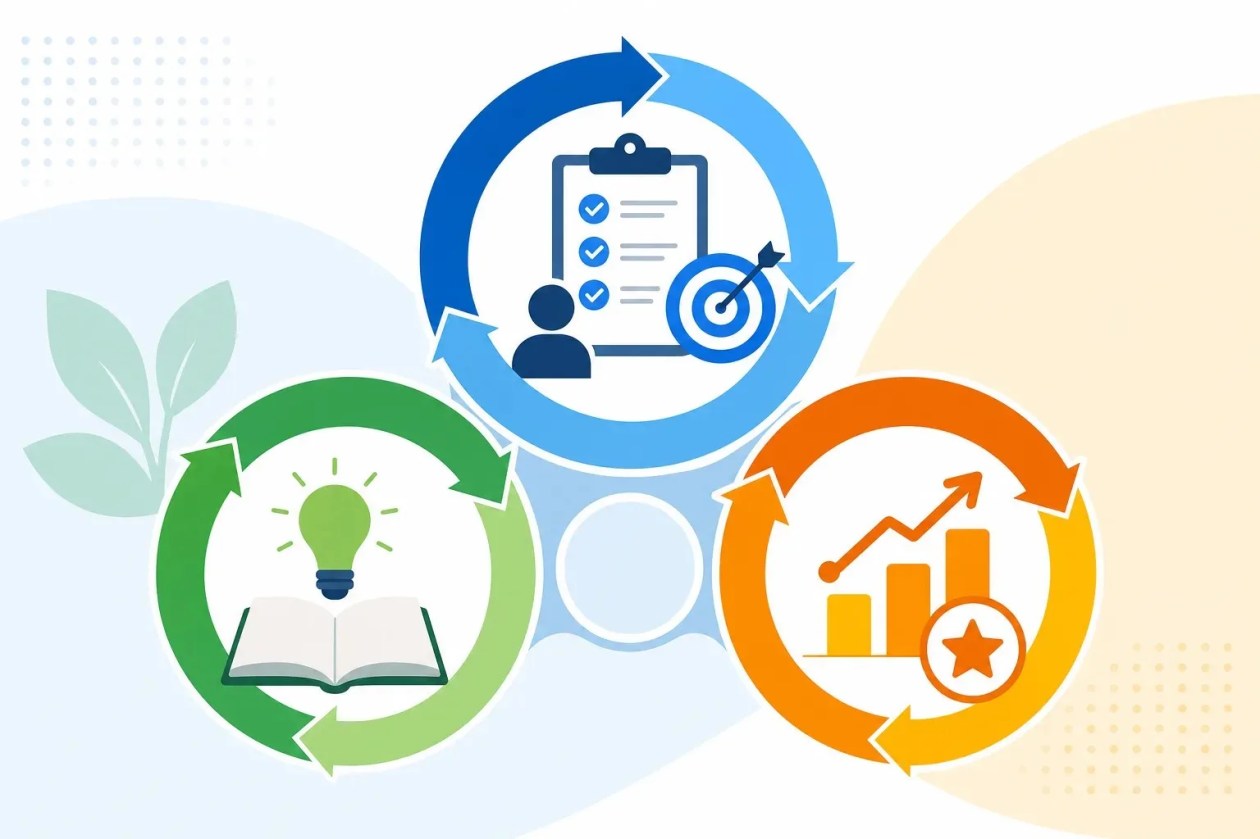
The CalAPA is built around three leadership cycles, and EDA 600A is designed to help you complete each one with steady support. Rather than treating the assessment as something to tackle all at once, this course breaks the work into manageable monthly milestones so you can focus, gather evidence, reflect on feedback, and move forward with confidence. As you learn what each cycle asks of you, you will also see how the course structure is meant to keep you on track towards your administrative credential.
What the three cycles are
The California Administrator Performance Assessment, or CalAPA, is made up of three leadership cycles: Leadership Cycle 1: Analysing Data to Inform School Improvement and Promote Equity, Leadership Cycle 2: Facilitating Communities of Practice, and Leadership Cycle 3: Supporting Teacher Growth. These are not separate add-ons; they are the core of the assessment. Each cycle focuses on a different aspect of leadership, but all three are connected by the same overall purpose: helping you demonstrate the knowledge, skills and judgement expected of a beginning administrator. For example, Cycle 1 asks you to look closely at data and use it to guide improvement and equity. Cycle 2 moves into working with others through communities of practice. Cycle 3 focuses on supporting teacher development. Together, they show a wider picture of your leadership practice.
How each cycle is structured
Each leadership cycle follows the same four inquiry steps: investigate, plan, act and reflect. This pattern matters because it gives you a clear way to think through your work. First, you investigate the situation and gather information. Then you plan your response. Next, you act by carrying out the leadership work in your setting. Finally, you reflect on what happened and what you learned. For example, in Cycle 1 you might investigate school data, plan an improvement approach, act by putting that plan into practice, and then reflect on the results. In Cycle 2, you might investigate a need within a group of staff, plan a collaborative meeting, act by facilitating it, and reflect on how well the community worked. In Cycle 3, you might investigate a teacher's growth area, plan support, act through coaching or feedback, and reflect on the impact.
Why EDA 600A focuses on one cycle at a time
EDA 600A is intentionally organised so that you do not have to carry all three cycles at once. Instead, the course uses a three-month roadmap: Month 1 for Cycle 1, Month 2 for Cycle 2, and Month 3 for Cycle 3. This approach keeps the work manageable and helps you build momentum. If you tried to leave all three cycles until the end, you could find yourself dealing with outdated evidence, lower confidence and unnecessary pressure. By focusing on one cycle each month, you give yourself a clear goal, a realistic timeline and a better chance of finishing before the course ends. For instance, you can spend the first month understanding Cycle 1 requirements, collecting artefacts and responding to feedback before moving on. That same pattern then repeats for Cycles 2 and 3.
What you do in Cycle 1, Cycle 2 and Cycle 3
In Month 1, your focus is Leadership Cycle 1: Analysing Data to Inform School Improvement and Promote Equity. During this stage, you examine the requirements, organise evidence, plan activities, collect artefacts, review writing expectations and use instructor feedback. The goal is to submit Cycle 1 before moving into Month 2. In Month 2, your attention shifts fully to Cycle 2: Facilitating Communities of Practice. At this point, assignments, coaching, feedback, office hours and peer collaboration all support that single cycle. The goal is to complete and submit Cycle 2 before Month 3 begins. In Month 3, you focus on Cycle 3: Supporting Teacher Growth. By then, you should already have momentum, more confidence and a better understanding of the CalAPA process. The aim is to submit Cycle 3 before EDA 600A ends.
Why this design helps you succeed
This monthly structure works because it reduces stress and increases completion rates. It turns a large, demanding assessment into a series of achievable steps. You are not expected to figure it out on your own; the course provides guided instruction, weekly checkpoints, clear timelines, assignment alignment, feedback, resources and encouragement. Your role is to stay engaged, complete work on time, gather evidence early, ask questions, use feedback and meet monthly deadlines. For example, if you collect evidence early in Cycle 1, you are less likely to feel rushed later. If you use feedback carefully after each submission, you can improve your writing and strengthen the next cycle. This is how the course helps you keep moving forward while building your skills as a leader.
The CalAPA is the course: every assignment, discussion, reflection and fieldwork activity is chosen because it supports your submission.
One course. Three months. Three cycles. One credential closer.
Key takeaways
- The three CalAPA cycles are the heart of the assessment, not extra tasks.
- Each cycle follows the same pattern: investigate, plan, act and reflect.
- EDA 600A is organised so you focus on one cycle each month, which makes the work more manageable.
- Your success depends on staying engaged, meeting deadlines, gathering evidence early and using feedback well.
- If you follow the monthly plan, you can finish all three cycles during the course and move one step closer to your administrative credential.
Leave a Reply