
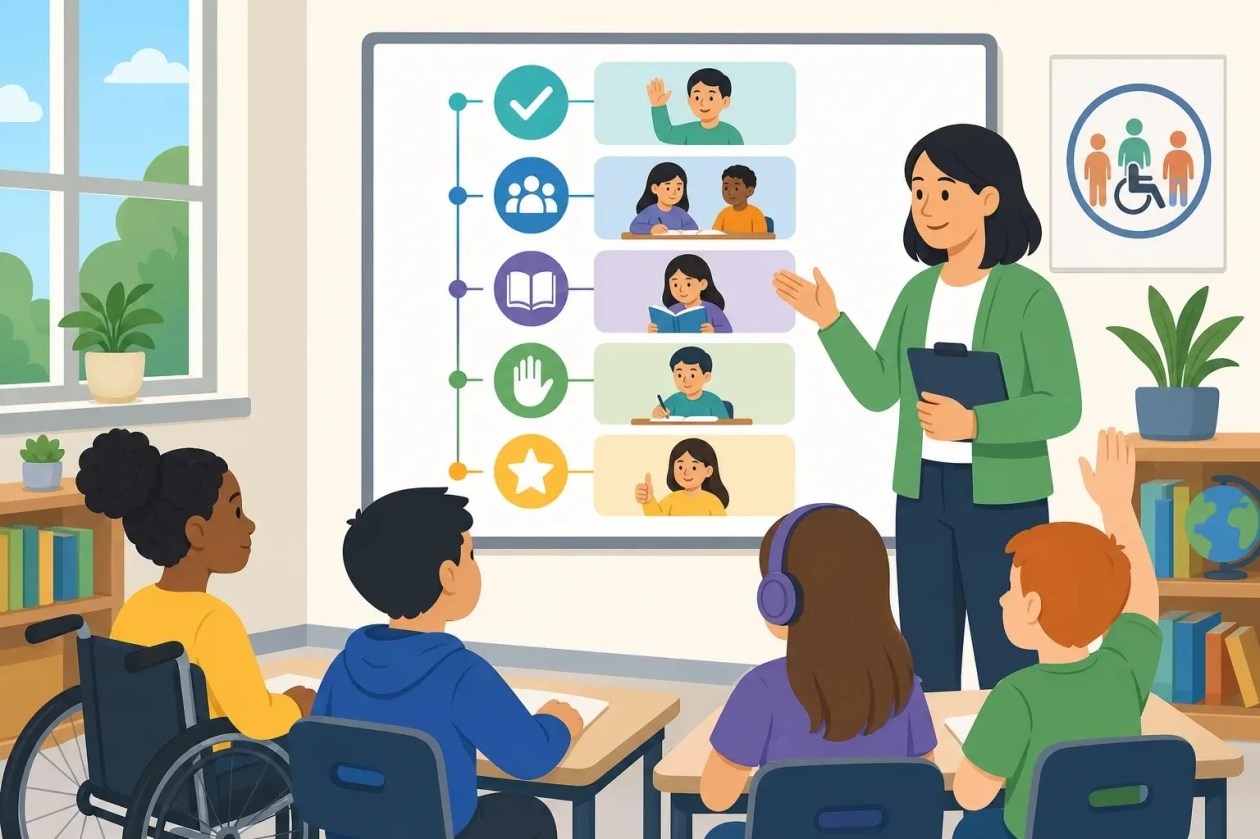
Clear instructions and routines help every child know what to do, when to do it, and how to succeed. In an accessible classroom, this is not just about being organised; it is about removing barriers so that all pupils, including those who process language differently or need more support with memory and attention, can take part fairly. When expectations are predictable and instructions are easy to follow, you reduce confusion, save time, and make learning more equitable.
Why clarity supports accessibility and equity
Accessibility in the classroom means that pupils can access the learning without unnecessary obstacles. Clear instructions support this by making the task itself easier to understand, rather than relying on pupils to guess what you mean. This matters for equity because pupils do not all start from the same place. Some may need language to be simpler, some may need steps broken down, and some may need the routine repeated to feel secure. When you make instructions clear, you are not lowering expectations; you are making the route to those expectations fairer.
If pupils have to work out the instructions before they can do the learning, the instructions have become a barrier.
What clear instructions look like in practice
Clear instructions are short, specific, and given in a sensible order. They tell pupils what to do, how much to do, and what success looks like. For example, instead of saying, “Get on with your work,” you might say, “Write three sentences about your favourite season. Start with a capital letter and end with a full stop.” That version gives a clear task and a clear standard. It is also helpful to pair spoken instructions with visual cues, such as a written checklist on the board, so pupils can refer back to them if they forget part of the task.
- Use short sentences and familiar words.
- Give one or two steps at a time, especially for younger pupils or new tasks.
- Say and show instructions, rather than relying on speech alone.
- Check understanding by asking pupils to repeat the task in their own words.
- Keep key routines consistent so pupils do not have to relearn them every lesson.
Building routines that support independence
Routines make the classroom more predictable, and predictability helps pupils feel safe and ready to learn. When pupils know what happens at the start of the lesson, how to ask for help, where to hand in work, and what to do when they finish early, they can work more independently. This is especially important in an inclusive school because routines reduce the need for constant adult prompting and help pupils who may struggle with transitions or executive functioning, which means organising and managing tasks.
- Teach the routine explicitly, rather than assuming pupils will pick it up.
- Model the routine first, then practise it together.
- Use the same language each time, such as “Do Now”, “Partner talk”, or “Pack away”.
- Give reminders before transitions, for example, “In one minute, we will stop and tidy up”.
- Review routines regularly, especially after holidays or when a new activity begins.
The teacher’s role in maintaining clarity
As a teacher, you set the tone for how accessible the classroom feels. Your voice, pacing, and consistency all matter. If you give instructions too quickly, change routines often, or add extra information halfway through, pupils may miss important details. By contrast, when you speak calmly, pause between steps, and stick to agreed routines, you help pupils focus on learning rather than trying to work out what to do next. This is a practical example of equity: you are making the classroom workable for more pupils, not just those who already find school easy.
A strong routine also helps when things go wrong. If a pupil is unsure, they can return to the routine instead of feeling lost. If the class becomes noisy or unsettled, a familiar signal or sequence can bring everyone back together. Over time, clear instructions and routines build confidence, reduce anxiety, and create a classroom where more pupils can participate fully.
Key takeaways
- Make instructions short, specific, and easy to follow.
- Teach routines explicitly so pupils know what to do without guessing.
- Use visual and spoken support together to improve access for more pupils.
- Consistency in classroom routines helps create a fairer learning environment for everyone.
Leave a Reply