
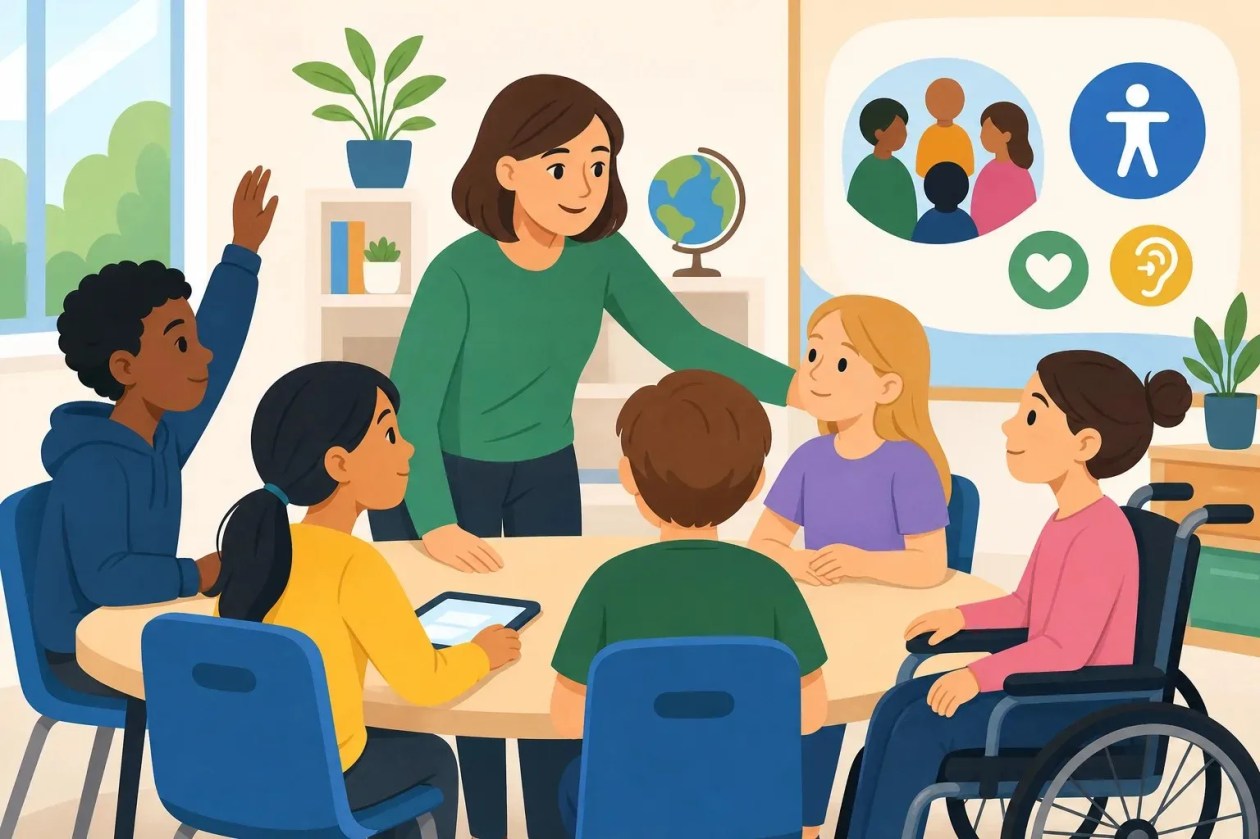
Accessibility in the classroom is about making sure every pupil can take part in learning, not just those who find school easiest. In an elementary school, that means noticing barriers early, adjusting routines and materials, and checking that your teaching works for a wide range of needs. From a teacher’s perspective, this is a practical part of fairness: when you remove barriers, you give more pupils a genuine chance to learn and belong.
What it means for pupils to ‘join in’
For pupils to join in, they need access to the same learning opportunities as their classmates. That includes being able to hear instructions, see resources, understand what is expected, move around safely, and take part in discussion, play, and group work. A child may be physically present in the room but still be excluded if the task, language, pace, or environment creates barriers. Accessibility is therefore not only about ramps or equipment; it is also about how you plan lessons, present information, and respond when a pupil struggles to participate.
If a pupil cannot access the task, they cannot fully access the learning.
Common barriers you should look for
When you check whether all pupils can join in, look for barriers in three main areas: the environment, the materials, and the activity itself. In the environment, noise, glare, cramped seating, or unclear display boards can make participation harder. In the materials, small print, dense text, unfamiliar vocabulary, or worksheets that rely on one mode of response may exclude some learners. In the activity, a task may assume a level of reading, writing, speaking, attention, or fine motor control that not every pupil has yet developed. For example, a science task that only allows written answers may prevent a pupil with writing difficulties from showing what they know.
How teachers can check access during a lesson
A useful approach is to build in quick checks before, during, and after teaching. Before the lesson, ask yourself whether every pupil can see, hear, read, and understand the task. During the lesson, watch for signs of confusion, withdrawal, frustration, or over-reliance on adult help. After the lesson, reflect on who took part fully and who did not, and why. This is not about waiting for pupils to fail; it is about noticing small problems early and adapting promptly.
- Preview the lesson materials and instructions from the pupil’s point of view.
- Check that key information is available in more than one way, such as spoken, written, and visual.
- Observe who is participating, who is quiet, and who needs repeated support.
- Adjust the task if needed by simplifying language, modelling the first step, or offering an alternative way to show learning.
- Review the lesson afterwards and note any barriers that appeared so you can plan differently next time.
What equity looks like in practice
Equity means giving pupils what they need to succeed, rather than giving everyone exactly the same thing. Two pupils may be doing the same lesson, but one may need larger print, another may need extra processing time, and another may need instructions broken into smaller steps. These are not unfair advantages; they are reasonable adjustments that make participation possible. From a school perspective, this matters because an equitable classroom reduces the gap between pupils who can access learning independently and those who need barriers removed first.
Teachers also play an important role in normalising difference. When you plan flexible activities, use clear routines, and invite multiple ways to answer, you show pupils that there are many valid ways to learn and contribute. That helps build confidence, reduces shame, and supports a classroom culture where every child is expected to take part.
A simple habit to keep accessibility in view
A helpful habit is to ask three questions about every lesson: Can every pupil get into the task? Can every pupil understand what to do? Can every pupil show what they know? If the answer to any of these is no, the lesson needs adjusting. Over time, this kind of checking becomes part of your professional practice and helps you create a classroom where access and equity are built in, not added later.
Key takeaways
- Check lessons from the pupil’s point of view: can they see, hear, understand, and take part?
- Look for barriers in the environment, the materials, and the activity itself.
- Use flexible teaching so pupils can show learning in different ways.
- Accessibility supports equity because it removes barriers and helps every child join in.
Leave a Reply