
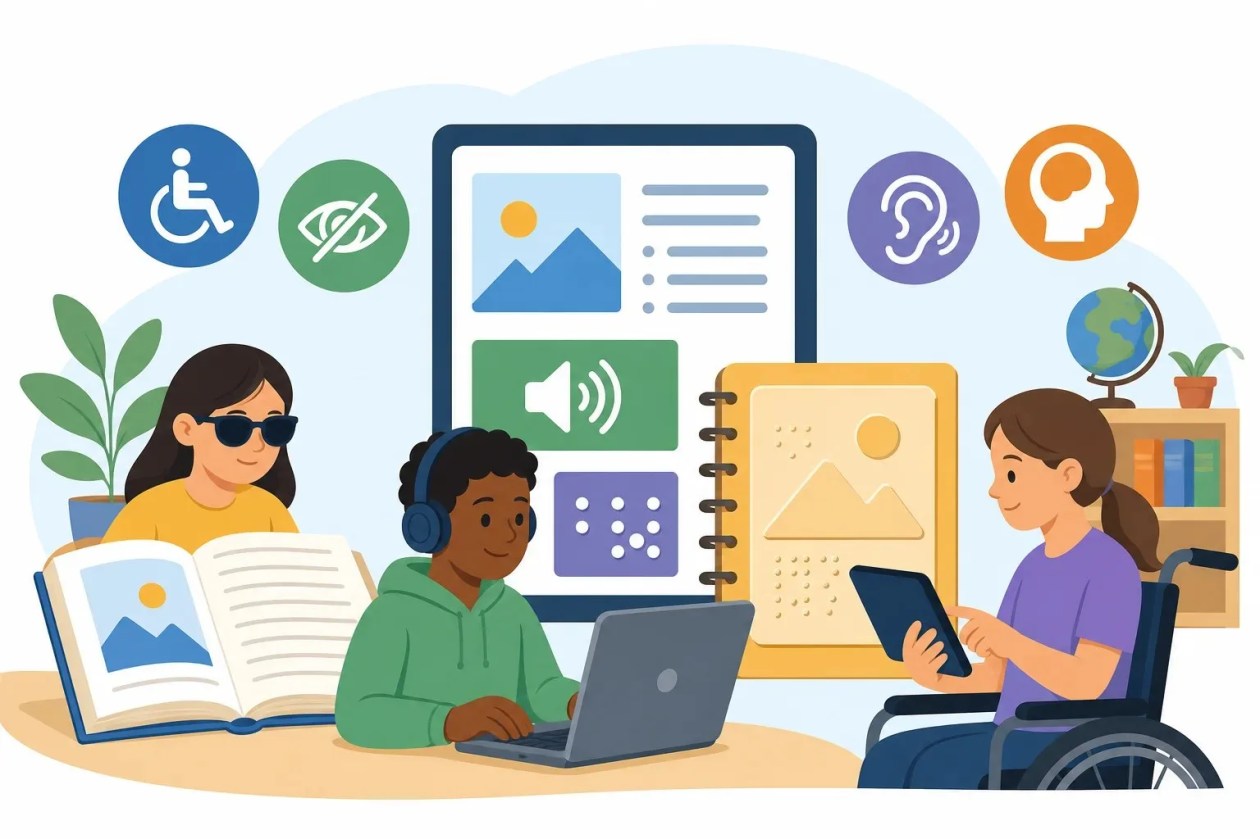
Accessible learning materials are the resources you give pupils to read, view, hear and use in class. When these materials are designed well, they remove barriers before they become learning problems. That matters for equity: if every child can access the same content in a way that suits their needs, they have a fairer chance to take part, understand and succeed.
Why accessible materials matter
In an elementary school classroom, pupils do not all learn in the same way. Some need larger print, clearer layout, audio support, simplified language or extra time to process information. Others may have a temporary difficulty, such as an injury, or may be learning English as an additional language. Accessible materials help all of these pupils without lowering expectations. They support inclusion by making the curriculum easier to reach, not easier in content.
From a teacher’s perspective, accessible materials reduce the need for constant workarounds during lessons. From an administrator’s perspective, they support a school culture where fairness is built into everyday practice rather than added later as an adjustment. In both cases, accessibility is closely linked to equity because it helps ensure that access to learning does not depend on a pupil’s background, language, disability or circumstances.
What accessible materials look like in practice
- Text that uses a clear font, good spacing and strong contrast between words and background.
- Instructions written in simple, direct language, with key points broken into manageable chunks.
- Images, diagrams and charts with labels or short explanations so pupils know what they show.
- Audio versions of texts or read-aloud support for pupils who need help with decoding or stamina.
- Captions or transcripts for video clips so pupils can follow the content in different ways.
- Digital files that can be enlarged, read with screen readers or edited to meet individual needs.
A useful example is a science worksheet. A non-accessible version may have crowded text, tiny pictures and several questions on one page. An accessible version might use more white space, one task at a time, a larger font and a picture with a clear label. The learning goal stays the same, but the material is easier to use for more pupils.
How teachers can design for access from the start
- Start with the learning goal and ask what barriers the material might create.
- Choose the simplest format that still teaches the idea clearly.
- Check that text, images and digital features all work together.
- Offer more than one way for pupils to receive information, such as print, spoken explanation and visuals.
- Review the material after use and note what helped or caused confusion.
Designing for access from the start is better than waiting for pupils to struggle and then making changes later. It saves time, reduces frustration and shows pupils that their needs are expected and respected. This is especially important in primary settings, where pupils are still building reading, language and self-advocacy skills.
Accessibility is not an extra feature; it is part of fair teaching.
The administrator’s role in supporting accessible materials
Administrators help by setting expectations, providing professional learning and making sure staff have the right tools. This can include shared templates, accessible digital platforms, captioning tools, screen-reader-compatible documents and time for teachers to review resources together. Leaders can also look at school policies to ensure that accessibility is treated as a normal part of planning, not an optional extra.
When school leaders model this approach, they strengthen equity across classrooms. A school that checks the accessibility of handouts, homework sheets, parent letters and online resources is less likely to leave pupils behind because of avoidable barriers. In that sense, accessible materials are not just a classroom issue; they are part of whole-school inclusion.
Key takeaways
- Accessible learning materials remove barriers so more pupils can take part in the same learning.
- Teachers can improve access by using clear layout, simple language, visuals, audio and flexible digital formats.
- Administrators support equity by giving staff the tools, training and expectations needed to make accessibility routine.
- Planning for access from the start is more effective than fixing problems after pupils have already struggled.
Leave a Reply