
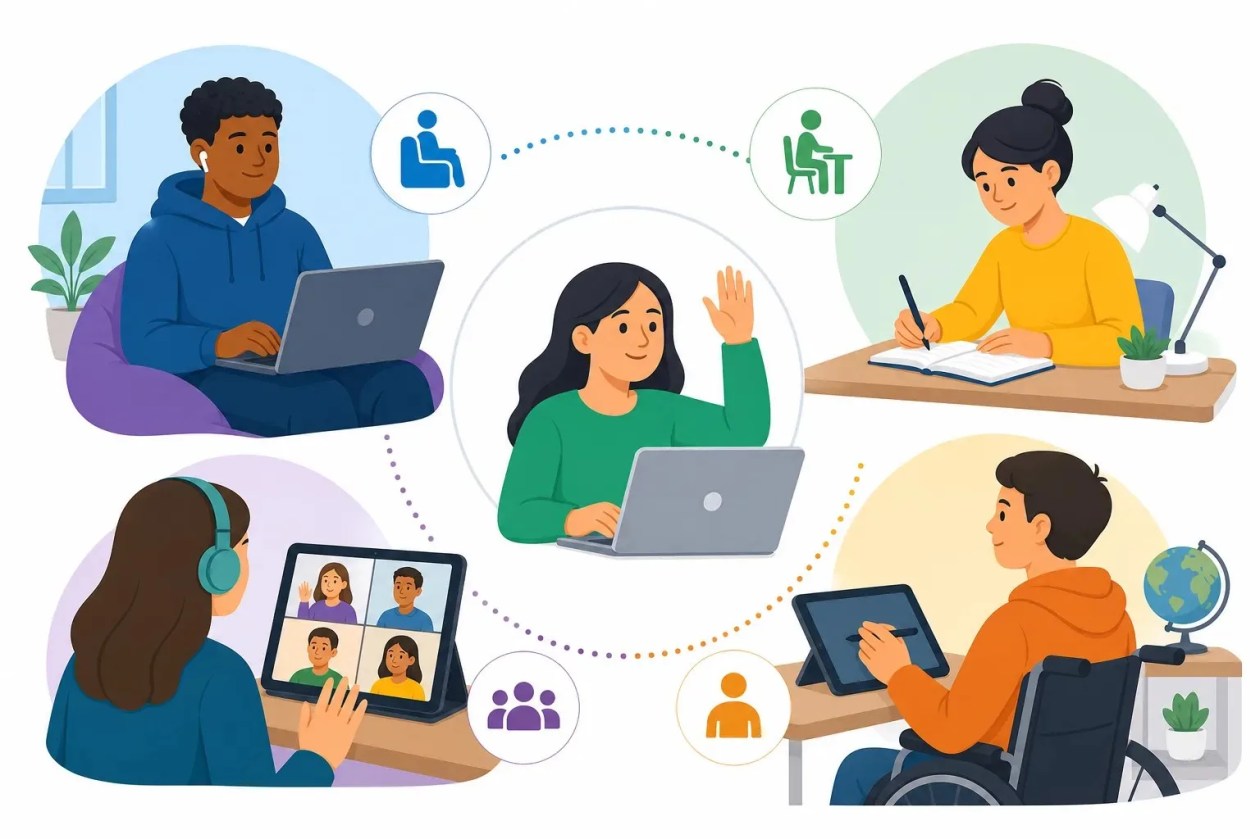
Accessibility is not just about helping a few pupils; it is about making sure every child can take part in learning in a way that works for them. In an elementary school, that means thinking carefully about how pupils join in, show what they know, and feel included in the classroom community. Flexible ways to take part support equity because they reduce barriers and give more than one route into the same lesson.
Why participation needs to be flexible
Children do not all communicate, move, focus, or process information in the same way. If a lesson only allows one kind of participation, some pupils are immediately placed at a disadvantage. For example, a child who finds speaking in front of the class difficult may still have strong ideas to share in writing, through drawing, or in a small group. Flexible participation helps you recognise that ability is not the same as one fixed method of showing it.
From an equity point of view, the aim is not to give every pupil the same task in exactly the same way, but to give each pupil a fair chance to access the learning. This is especially important in school systems that aim to remove barriers rather than expect children to fit a narrow model of participation.
Ways teachers can offer choice in the classroom
As a teacher, you can build flexibility into everyday routines without lowering expectations. The key is to keep the learning goal the same while offering different ways to join in. For instance, during a science lesson, pupils might answer questions by speaking, using picture cards, writing a short response, or working with a partner to explain their thinking. In a reading lesson, they might discuss a story, act out a scene, complete a graphic organiser, or record an audio response.
- Offer more than one way to respond, such as speaking, writing, drawing, acting, or using digital tools.
- Use small-group discussion or partner talk before whole-class sharing to reduce pressure.
- Allow pupils extra processing time so they are not rushed into answering.
- Provide sentence starters, visual prompts, or word banks to support participation.
- Check that classroom routines invite all pupils to contribute, not only the most confident speakers.
Flexible participation is not an extra; it is part of making learning fair for everyone.
What school leaders can do to support accessible participation
Administrators play an important role in making accessibility a school-wide expectation rather than an individual teacher choice. When leaders support flexible participation, they help create consistency across classrooms and reduce the chance that access depends on which teacher a child has. This can include encouraging inclusive lesson planning, providing professional development, and making sure classroom resources and technology are available to support different forms of participation.
Leaders can also review school routines, assemblies, family events, and assessment practices to see whether they allow all pupils to take part. For example, if every school event depends on fast verbal responses, some children will be excluded even if the intention is inclusive. A school committed to equity looks at participation across the whole day, not only during lessons.
Planning for inclusion without lowering standards
Flexible ways to take part should never mean making the work easier in a way that reduces challenge. Instead, it means removing unnecessary barriers so pupils can show genuine understanding. A pupil who gives an oral explanation with visual support is still being challenged to think deeply; a pupil who writes less because they use assistive technology is still meeting the same learning goal. The standard stays high, but the route is more accessible.
When you plan this way, you are more likely to see the real strengths of your pupils. Some children will shine when given time to rehearse; others will do best with movement, pictures, or technology. The classroom becomes a place where participation is expected from everyone, but not forced into one narrow form.
Key takeaways
- Plan for more than one way for pupils to join in and respond.
- Keep the learning goal the same, but vary the route into it.
- Use flexible participation to reduce barriers and support fairness.
- School leaders should make accessibility a shared expectation across the whole school.
Leave a Reply